When Does Spousal Support End? Three Cases Every Woman Should Understand
5 minute readCan spousal support eventually come to an end after a 25-year traditional marriage, even when the recipient spouse cannot work because of serious health problems and says family violence contributed to her PTSD?
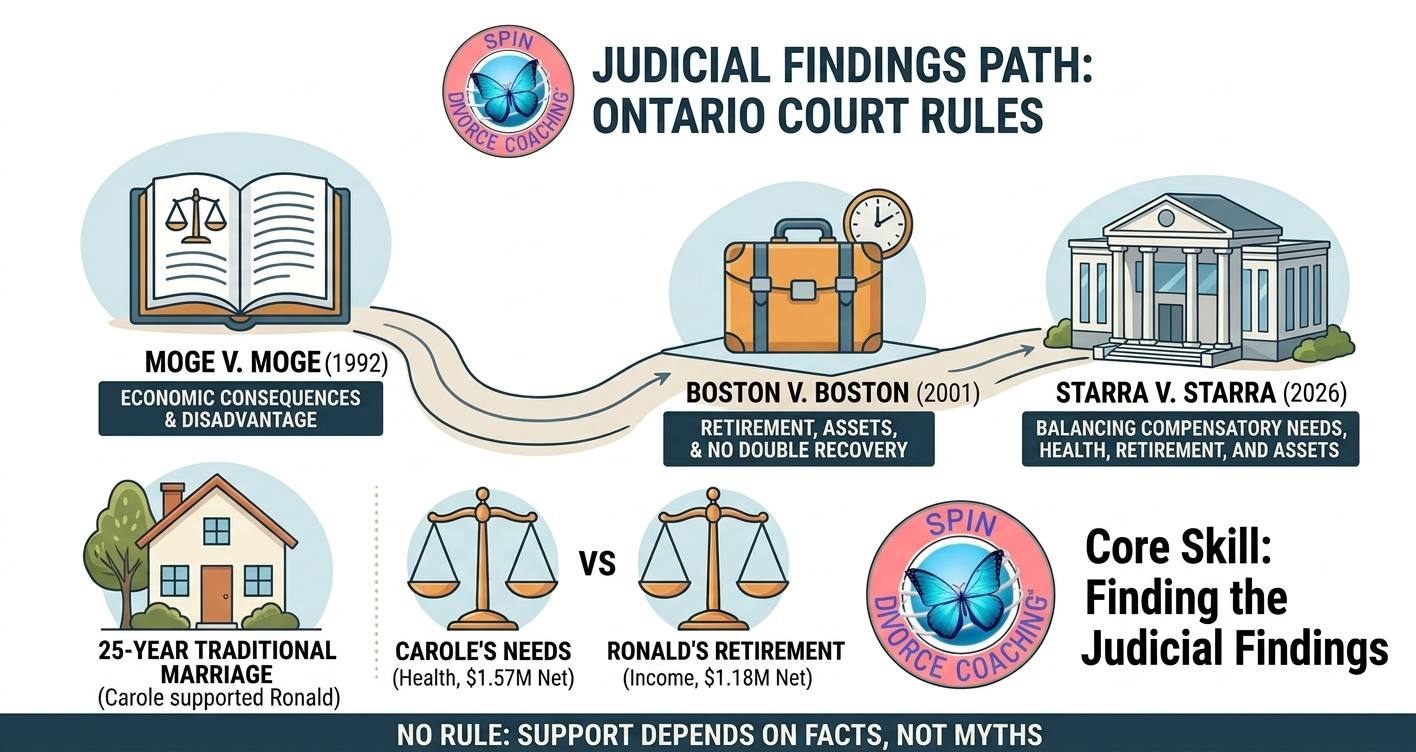
A recent Ontario Court of Appeal decision, Starra v. Starra, 2026 ONCA 405, illustrates how Ontario courts approach that question. But to understand Starra, it helps to first understand two landmark Supreme Court of Canada decisions that continue to shape spousal support law: Moge v. Moge and Boston v. Boston.
Moge: Marriage Can Create Lasting Economic Disadvantage
Moge v. Moge, 1992 CanLII 25 (SCC), fundamentally changed the way Canadian courts approach spousal support.
The Supreme Court rejected the idea that support should primarily be a temporary bridge to self-sufficiency. Marriage can create lasting economic advantages for one spouse and lasting economic disadvantages for the other. A spouse may give up career opportunities, education, promotions, pension benefits, or earning capacity while caring for children or supporting the other spouse's career.
Those economic consequences do not necessarily disappear when the marriage ends.
This is the foundation of compensatory spousal support. The question is not simply, "Can this person work?" It may also be, "What economic consequences did this marriage create, and who should bear those consequences after separation?"
That principle is particularly important in long-term traditional marriages. However, Moge does not stand for the proposition that compensatory support continues forever.
_______________________________________________________
Boston: Retirement Can Change the Analysis
That became clearer in Boston v. Boston, 2001 SCC 43.
In Boston, the Supreme Court considered what happens when the support-paying spouse retires, particularly where the recipient has already received property that reflected the value of the payor's pension.
The Court cautioned against double recovery. In other words, if the value of a pension has already been taken into account during the division of property, the recipient cannot necessarily expect the payor to continue funding support indefinitely from the same retirement assets.
That does not mean retirement automatically ends spousal support. Rather, retirement may fundamentally change the financial circumstances that a court must consider when deciding whether support should continue and, if so, in what amount.
Applying Those Principles in Starra
R.S. and C.S. were married for 25 years. It was a traditional marriage in which C.S. stayed home and supported R.S.'s medical career.
They separated in 2007 and ultimately resolved spousal support through a consent order in 2013—a critical reminder of why understanding why consent orders matter before signing anything is so important. R.S. agreed to pay C.S. $15,500 per month, together with a lump-sum payment of $100,000.
Over the next eleven years, R.S. paid more than $2.1 million in spousal support.
During that time, C.S.'s circumstances also changed. She developed significant physical and psychological health problems and remained unable to work. Her medical expenses increased substantially. She argued that PTSD arising from family violence during the marriage contributed to her inability to become self-sufficient.
Then R.S. began preparing for retirement, which significantly changed the financial picture.
The motion judge found that both parties had experienced a material change in circumstances. C.S.'s health had deteriorated and her expenses had increased, while R.S.'s retirement would substantially reduce his income. The judge therefore reconsidered the existing support order.
Importantly, the judge recognized that C.S.'s entitlement was based on both compensatory and non-compensatory principles. R.S.'s retirement did not erase the economic consequences of their 25-year marriage.
The judge also carefully considered the evidence concerning family violence and PTSD. She accepted that C.S. suffered from PTSD but concluded that the evidence did not establish R.S. as its sole cause, as the record also included evidence of significant childhood trauma. The judge further found that some of the increased medical expenses resulted from C.S.'s treatment choices.
The Court of Appeal did not suggest that family violence is irrelevant to spousal support. Rather, it concluded that the motion judge had properly considered the evidence and made findings that were open to her on the record.
The judge also examined the parties' overall financial circumstances:
C.S.'s net worth was approximately $1.57 million, while R.S.'s was approximately $1.18 million.
R.S. had already paid more than $2.1 million in spousal support and was approaching retirement, which C.S. did not dispute he was entitled to do.
The fact that R.S. had paid more than $2.1 million was relevant, but it was not a mathematical threshold for ending support. The court considered that history together with the parties' assets, R.S.'s retirement, C.S.'s ongoing needs, and the objectives of spousal support.
The judge concluded that compensatory support should continue for a further transitional period, ending on September 30, 2026. Support was gradually reduced from $15,500 per month to $5,999 per month during part of 2024, and then to $1,423 per month through September 2026.
C.S. appealed, and the Court of Appeal dismissed the appeal.
++++++++++++++++++++++++++++++++++++++++++++++++++++
Why the Decision Matters
The Court of Appeal did not depart from the principles established in Moge, nor did it hold that retirement automatically ends spousal support. Instead, the Court confirmed that the motion judge had properly applied the principles from both Moge and Boston to the particular facts of the case. It also emphasized that appellate courts owe considerable deference to discretionary support decisions.
C.S. also sought a retroactive increase in support dating back to 2014, which failed. The original consent order did not require annual financial disclosure or annual adjustments—one of the hidden financial traps that make Ontario family court so terrifying if you don't know what terms to ask your lawyer to include upfront. Over the years, C.S. received legal advice, and her lawyers repeatedly requested information needed to pursue a variation, yet she did not bring her motion until 2022 after R.S. began planning for retirement.
The motion judge concluded that ordering retroactive support would cause significant hardship to R.S., and the Court of Appeal found no reversible error. The appeal was dismissed, and C.S. was ordered to pay $17,500 in costs.
What This Means for Women Going Through Divorce
These three cases work together:
Moge teaches that marriage can create lasting economic disadvantages that may justify compensatory spousal support.
Boston reminds us that the analysis does not occur in a vacuum—retirement, property division, pensions, and each spouse's financial resources can significantly affect whether support should continue.
Starra demonstrates how those principles are applied in a real case involving a 25-year traditional marriage, serious health problems, allegations of family violence, retirement, substantial assets, and more than $2.1 million in support already paid.
For women going through divorce, there is no rule that spousal support lasts forever, and no rule that support automatically ends when the payor retires. Every case turns on its own facts. Courts look at the economic impact of the marriage, the parties' current financial circumstances, retirement, assets, ongoing needs, and the purposes that spousal support was intended to serve.
That is why reading the actual decisions on CanLII matters. The law is rarely as simple as the version repeated in a courtroom, a Facebook group, or even during a casual conversation. Sometimes the best question you can ask is: What did the judge actually say?
If you want to learn how to navigate family court records, ask your lawyer targeted questions, and protect yourself from costly procedural traps, explore The Ultimate Ontario Divorce Survival Toolkit for Women or book a 1-on-1 coaching session with Lorraine Lawson of Spin Divorce today.
Disclaimer: The information provided in this article is for general informational and educational purposes only and does not constitute legal advice. Reading this content, or utilizing resources such as checklists and guides, does not establish a coach-client or legal-client relationship. Family law rules, court procedures, and timelines vary by jurisdiction and are subject to change. You should consult a qualified family law lawyer licensed in your jurisdiction to obtain advice tailored to your specific legal circumstances.